Family business since 1932
Four generations of pawnbroking
You can find Germany’s largest private pawn lending institution 18 times across Germany. We lend on jewellery, luxury watches, high-quality current hi-fi equipment as well as consumer electronics, photographic equipment and much more…

4
generations of family ownership
90+
years of experience with pawn loans
18
branches in 9 cities
150+
employees, including experienced appraisers
Our history
From safe factory to 9 cities
The story of Grüne’s Leihhäuser begins long before the first pawn ticket – with a Hamburg entrepreneur who turned a failed loan into a family business.
-
1921–1932
From safe factory to pawnshop
When Heinrich Carl Hermann Grüne was born in Hamburg in June 1898, no one could have foreseen that he would one day shape the pawnbroking trade. His father Friedrich Grüne ran a small locksmith’s workshop that had switched to making safes. His father’s early death forced him to take over the business soon after completing his training in 1921.
From the very beginning, Hermann Grüne proved to be an exceptionally gifted entrepreneur. Together with master locksmith Karl Otto Kegel, he founded the “Geldschrankfabrik Grüne & Kegel” (Grüne & Kegel safe factory) in October 1921. The business was extraordinarily successful, so that the safes not only found customers in Hamburg but were delivered all over the world.
At the end of the 1920s, business stagnated as the Great Depression cast its shadow ahead. At the first signs of a lasting decline in sales, Hermann Grüne drew the entrepreneurial consequences and shut down production. Karl Otto Kegel had already left the company in 1927, and the joint company was dissolved on 30 April 1927.
In the spring of 1932, he was approached by a certain Eggert Peters, a jeweller and pawnshop owner who had run into difficulties and was looking for capital.
He therefore turned to Hermann Grüne, who was known to have considerable capital. As security for a short-term loan, Peters offered a diamond ring whose expertly appraised value clearly exceeded the loan amount of 15,000 Reichsmarks paid out. With this, Hermann Grüne had, perhaps without realising it, completed his first pawn loan transaction.
However, when Eggert Peters was unable to repay the loan after the agreed period, he offered to sell Grüne his pawnshop at Michaelisbrücke 1. Only at this point did Hermann Grüne seriously engage with the pawn loan business. He examined the balance sheets and the stock of pledges and found that the pawnshop was basically well run. So he bought the pawnshop, took over its management in October 1932 and thus opened a new chapter in his career as an entrepreneur. And in the history of the pawn lending industry.
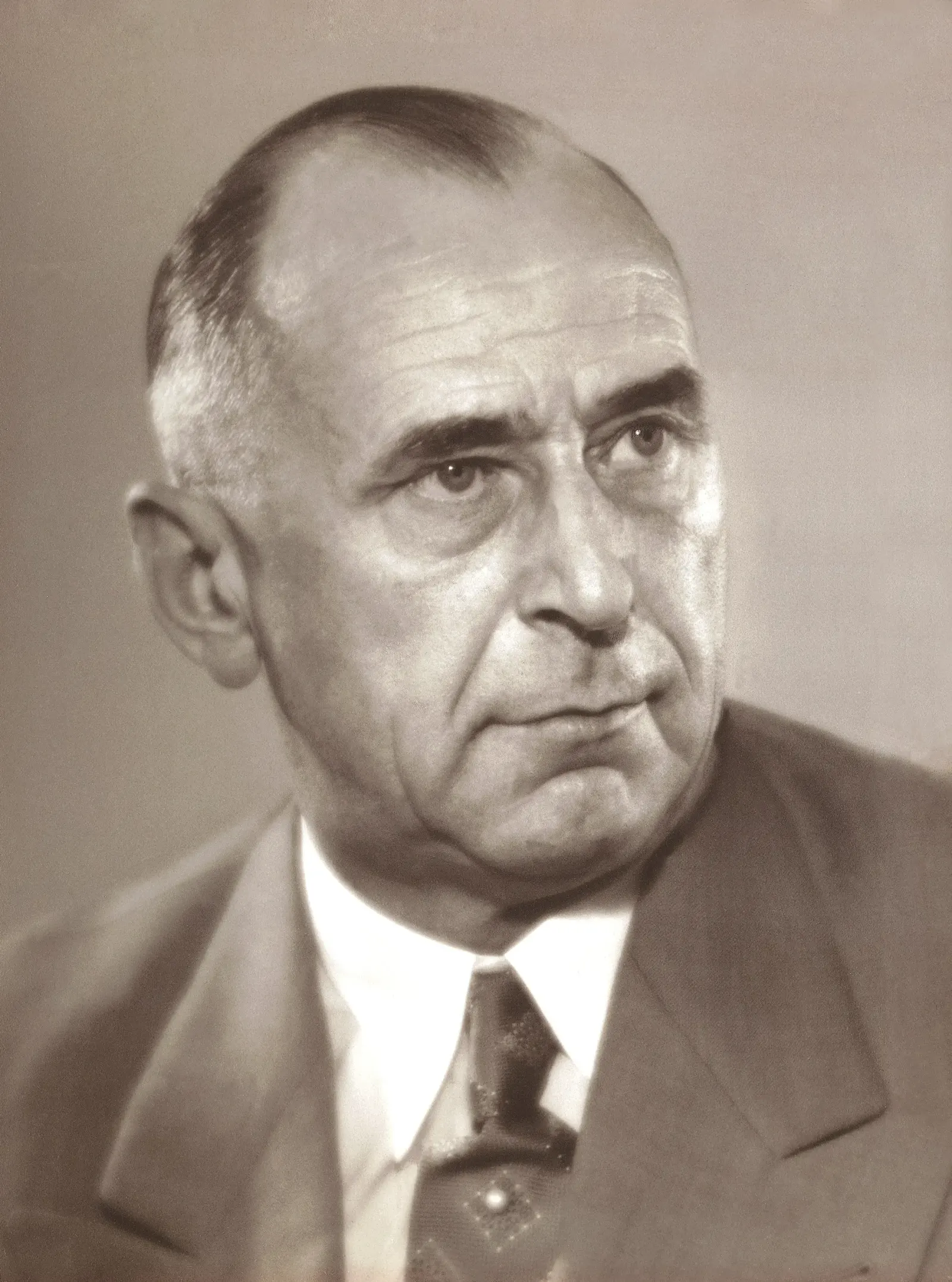
Hermann Grüne (1898–1964) -
1932–1939
The fight against a bad reputation
When he took over the pawnshop, he noticed the obvious contradiction between the reputable business practices of, at least, his own pawnshop and the poor public image of pawn loans. The legal framework that had applied throughout Germany since the Prussian Pawnbroking Act of 1881 had turned private pawnbroking into a respectable trade.
Nevertheless, the industry was still frowned upon by the public and considered disreputable. For its part, the industry avoided making itself conspicuous in public. Most pawnshops operated inconspicuous or hidden premises away from the busy shopping streets, in small alleys, backyards or, like the pawn office at Michaelisbrücke, on the unobtrusive upper floor of larger commercial buildings. They shied away from public attention and relied instead on word of mouth from their customers.
Hermann Grüne was not willing to accept the unjustified bad reputation that came with his new profession. On the contrary, he was determined to reverse the trend and work on improving the reputation of the pawnbroking trade. Unlike his predecessor, Grüne was not afraid to draw attention to his pawnshop through advertising. Not only through advertisements in the Hamburg newspapers or through leaflets, but also through what was then new-fangled and spectacular neon advertising on the building. This was new in the industry and clearly set the pawnshop at Michaelisbrücke apart from the many other pawnshops in Hamburg.
Precisely because he was convinced that pawnbroking was a reputable industry with a future, he strictly followed entrepreneurial criteria in developing his own business. Only small gains could still be achieved at the pawnshop at Michaelisbrücke, so further growth had to come from opening branches that would carry the successful business model into other districts. In June 1936 the time had come: the first branch opened in Große Bäckerstraße, starting business under the name “Leihhaus an der Börse”. Only now could one speak of “Grüne’s Leihhäuser” for the first time. A year later, Grüne became the market leader in Hamburg by opening two more branches: in October 1937, Grüne’s Leihhäuser opened in quick succession in Dammtorstraße and in Hamburg-Altona.
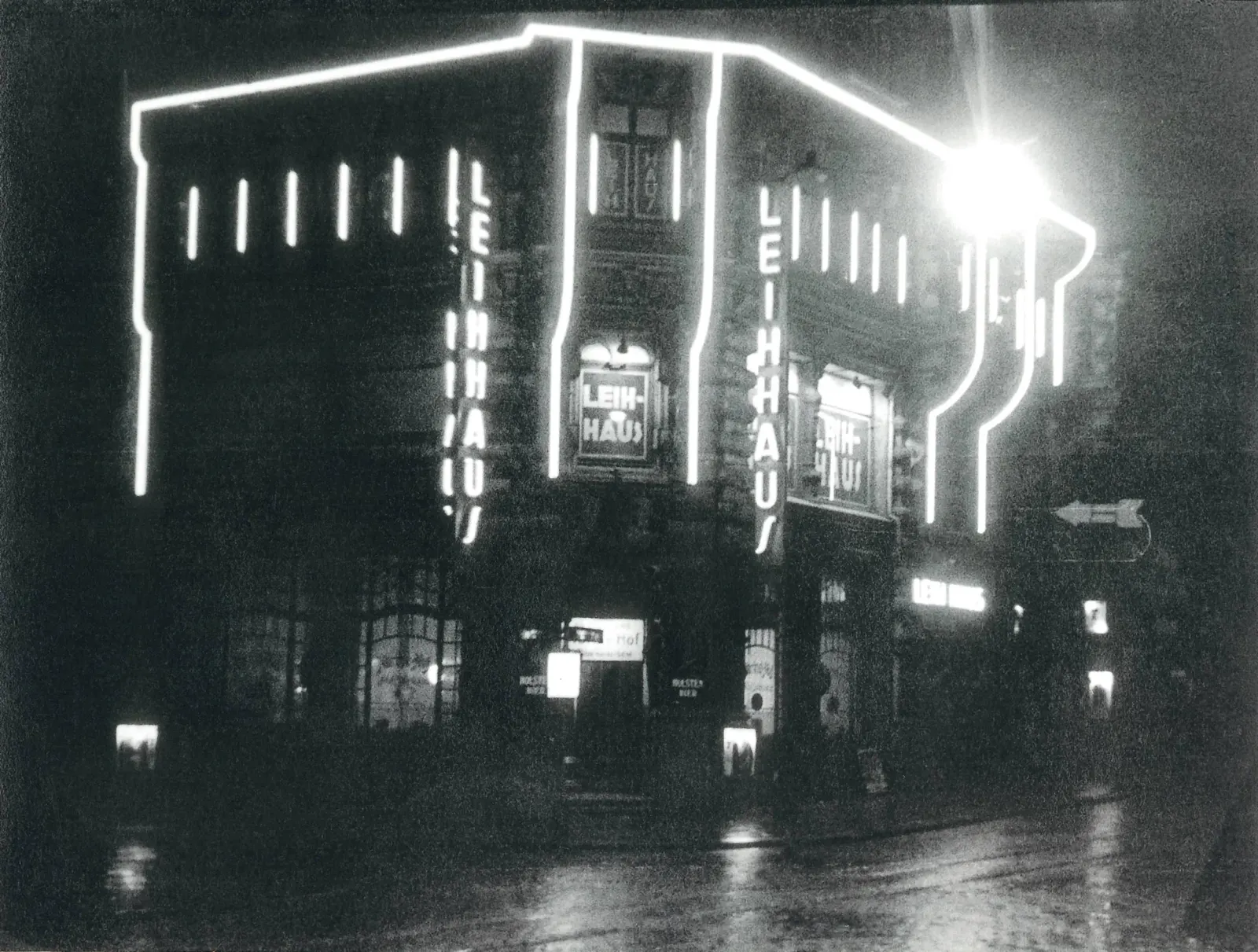
Pawnshop at Michaelisbrücke -
1939–1952
Grüne’s Leihhäuser during the war and afterwards
As the war progressed, however, its increasingly noticeable economic effects overshadowed developments in the pawn business. Sales fell, customer numbers declined and business languished. Finally, the bombing raids were added to the crisis caused by the war economy.
As if by a miracle, however, none of the four pawnshops was destroyed. Only the pawnshop at Michaelisbrücke was damaged, but it remained usable. The other branches survived the bombing unscathed. Although Grüne’s four pawnshops kept their doors open until the end of the war, normal business operations were no longer possible.
Only when signs of success in Germany’s reconstruction emerged and economic regulation by the Western occupying powers eased did demand in the pawn loan business rise again, so that Hermann Grüne once again turned his attention more strongly to his overarching goal: raising the standing of his industry.
The founding of the Federal Republic of Germany in May 1949 created the conditions for him to extend his commitment as an entrepreneur beyond the region and into economic policy. His efforts led to the founding of the Zentralverband Privater Leihhausbetriebe e.V. (Central Association of Private Pawnshops) in November 1950. Given his merits in the run-up to its founding, it was only logical that the constituent general meeting elected him as the first chairman of the new association. In its first year, around 100 pawn lending businesses belonged to the association. By the end of 1953, the number had risen to 132 member businesses. After all, in order to permanently improve the industry’s public image, pawn lending also had to consistently match the desired image and commit itself collectively to reputable and regulated business practices. Despite many standards and legal requirements already achieved at the time, there were still a number of shortcomings and problematic business practices in the pawnbroking trade, which Grüne openly fought against from the outset. Grüne was not afraid to denounce shady dealings and to combat them openly at association level.
Hermann Grüne’s reform agenda can be summed up in one word: standardisation. Standardisation of the legal framework, the professional profile and the business rules of pawnbroking, so that it could present itself to customers as a modern service sector on a clearly regulated basis and gain appropriate recognition as such.
In his own businesses in Hamburg, Grüne implemented this concept in a targeted way: his branches were not located in backyards but on busy shopping streets, offered well-kept premises and presented themselves to customers as correctly and competently run businesses of a uniformly organised company. Objectivity and transparency in business transactions were the priority and were geared to the interests of customers, who found reliable partners in Grüne’s Leihhäuser. The concept proved extraordinarily successful, as shown by the steadily rising pawn volumes, whose growth in these years (1949–1953) was still well above the already remarkable average growth of the pawnbroking trade as a whole.
In February 1952, Grüne further expanded his leading position in the Hamburg pawn loan business and opened his fifth pawnshop, this time in Barmbek on Fuhlsbüttler Straße.
-
1953–1960
Expansion from Hamburg to Munich
At the beginning of the 1950s, Hermann Grüne prepared a step that would prove revolutionary for the industry. He planned to build a nationwide pawnshop brand with pawnshops from Hamburg to Munich. At the end of 1952 he submitted applications to various city administrations. The applications were initially rejected because of fears for the municipal pawnshops. Only the city of Essen gave Grüne permission to open branches there. The year 1953 marked both a turning point and a breakthrough for Grüne’s Leihhäuser. Practically overnight, the Hamburg family business became a company operating nationwide. Such a step was revolutionary for the entire industry: among the roughly 130 West German pawn lending businesses, only a few companies had branches, and these were without exception located in the same city. Never before had a pawnbroker stepped outside the local framework, let alone done business beyond the borders of their own federal state.
As with the first expansion within Hamburg, Hermann Grüne also relied on his family when setting up the first branch outside the city. His son Raymond had been trained as an experienced pawnbroker in previous years and was now to be entrusted with this responsible task.
In 1953, the first Essen pawnshop opened at the Essen water tower. It quickly became clear that Grüne’s Leihhäuser would also be successful in the Ruhr area.
Hermann Grüne had been right in his assessment that the densely populated Ruhr area offered enormous market potential for modern pawnbroking. This is why the second Essen pawnshop opened in Altenessen in 1958.
Hermann Grüne was not deterred in his expansion efforts by the rejection of his licence applications by the cities of Düsseldorf, Frankfurt and Munich. Instead of concentrating on cities that were more liberal in granting approval, he went on the offensive and lodged appeals against the negative decisions with the responsible administrative courts. After Düsseldorf first granted approval, Frankfurt followed suit. The rulings paved the way for Grüne’s entrepreneurial success, because now nothing stood in the way of the further growth of Grüne’s Leihhäuser.
As early as May 1954, he opened Grüne’s pawnshop number 7 in Düsseldorf.
The founding of the Düsseldorf branch in May 1954 was followed in November 1955 by the founding of pawnshop number eight in Dortmund. Shortly before the turn of the year, Hermann Grüne also opened a sixth branch in the Hanseatic city on Hamburg’s Dehnhaide, number nine nationwide. In October 1956, Grüne’s Leihhäuser launched in Duisburg (number 10) and in November 1957 – after the Federal Administrative Court had cleared the way – the long-planned pawnshop (number 11) in Munich was also able to welcome its first customers. With the second branch in Essen, in the Altenessen district, Grüne’s Leihhäuser reached a dozen in December 1958. Branch 13 followed in Duisburg Hamborn in July 1959, and in November 1959 Hermann Grüne provisionally completed his conquest of the Ruhr area by opening his pawnshop number 14 in Gelsenkirchen. By this time, Grüne’s Leihhäuser already employed 85 people.
In August 1961, a second branch in Düsseldorf and a seventh Hamburg branch were added, and the following year Grüne opened yet another branch in Hamburg, in Bramfeld. By now there were 17 Grüne’s Leihhäuser in Germany.
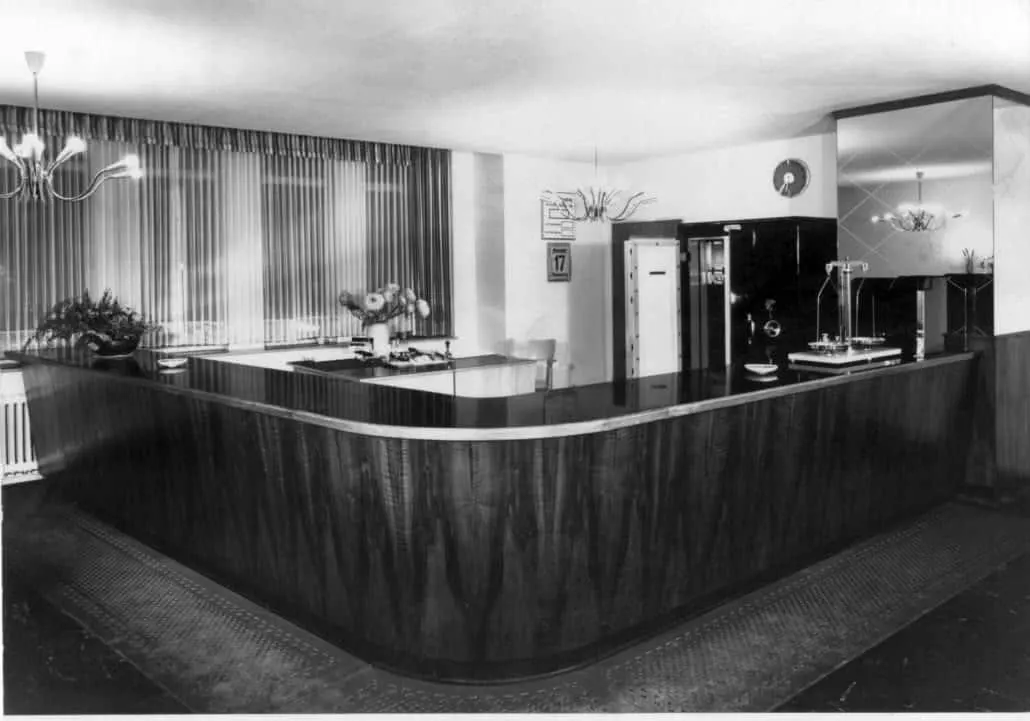
Dortmund branch around 1960 -
1960–1980
From the first to the second generation
The company’s fortunes were still personally directed by its founder Hermann Grüne, although his son and successor Raymond was by now running large parts of the day-to-day business.
No one had expected his health to deteriorate dramatically during 1964. Hermann Grüne died unexpectedly on 12 December 1964, mourned by his family and by the pawn lending trade.
After Hermann Grüne’s death, the management of the pawnshop chain was in effect in the hands of Raymond Grüne and the lawyer Herbert Martin. After the breathless growth phase of the 1950s, the management duo succeeded in consolidating Grüne’s Leihhäuser and developing the rapidly grown company structure into a stable system.
New openings now became less frequent: at the beginning of 1966, Grüne junior founded a third branch in Essen-West to relieve the two Essen branches. In December 1969, the long-planned pawnshop in Frankfurt was finally set up – more than a decade after the sensational ruling of the Federal Administrative Court against the Frankfurt city authorities. In November 1970, Grüne’s Leihhäuser also expanded to Cologne, and in December 1971 the second Munich branch began operating. The company now had twenty pawnshops – Grüne’s Leihhäuser stood out ever more clearly from the rest of the industry and further expanded its market leadership.
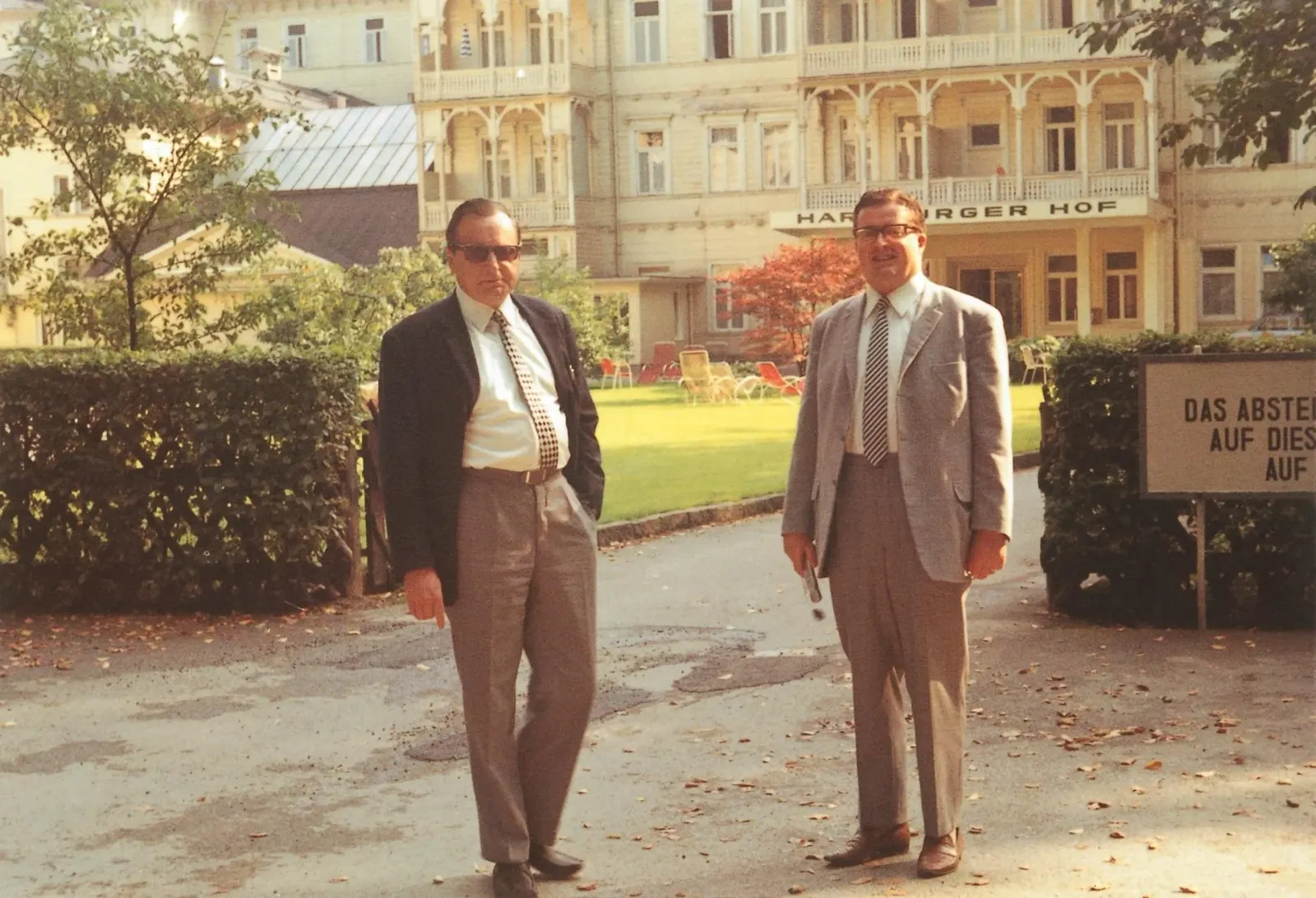
Raymond Grüne (left) and Herbert Martin (right) -
1980–2007
From the second to the third generation
In 1983, Grüne’s Leihhäuser celebrated its 50th anniversary and had every reason to look back with pride: the second generation of the family business had also proved itself and achieved remarkable things. In the difficult 1970s, Raymond Grüne had succeeded in maintaining market leadership and, contrary to the industry trend, achieving constant growth in the company’s own accounts.
Meanwhile, the third generation was already moving into the management of the company: Axel Grüne, Raymond Grüne’s son, born in 1962, had, like his grandfather, completed a banking apprenticeship in Hamburg after leaving school before being trained as a pawnbroker in the company.
Over the following years, the focus was initially on optimising the locations, which resulted in several moves to more suitable and busier locations, for example in Frankfurt, Hamburg, Düsseldorf, Cologne and Munich. In two cases, however, the local business situation also made new openings possible, which served to relieve the existing pawnshops and improve customer service: in Munich, a third branch was set up in 1985 in preparation for the forthcoming closure of the municipal pawnshop. In Frankfurt, demand was so high that a second branch was able to open in 1989 – on the Zeil, Frankfurt’s traditional city-centre shopping street. This increased the number of Grüne’s Leihhäuser to 22 across Germany.
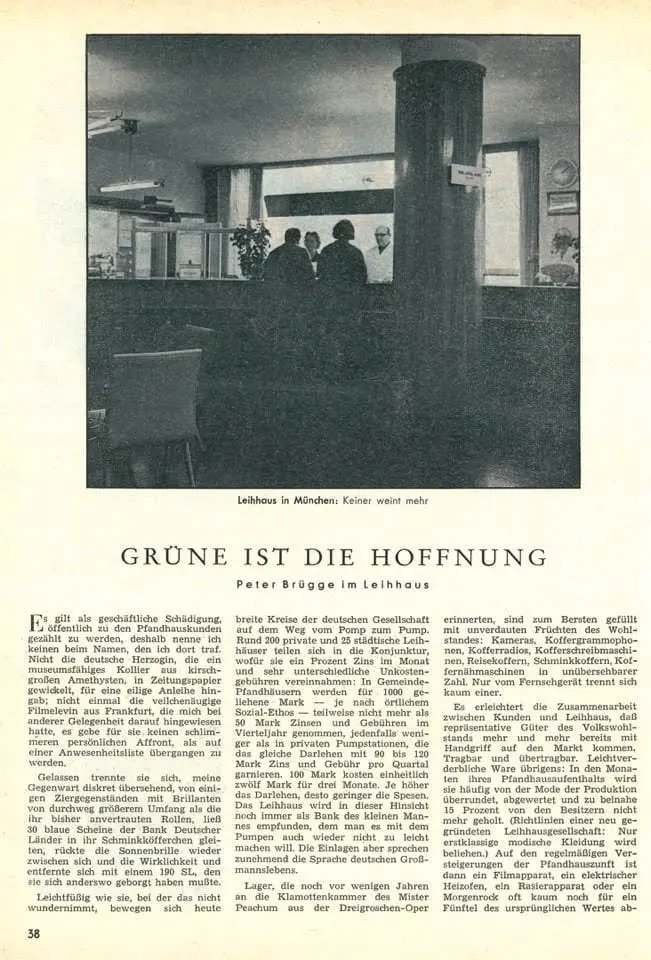
Magazine article “Grüne ist die Hoffnung” (“Green is hope”) -
Grüne’s Leihhäuser today
Despite its size, the company has not forgotten its roots and has remained true to its founder’s principles. As ever, the customer – the “ordinary person”, whose bank the company continues to be – is at the centre, and Grüne’s Leihhäuser owes its lasting success to this customer focus.
Instead of focusing mainly on high-value jewellery pledges and large loan amounts, Grüne’s pawnshops still live by the old company slogan: “Grüne’s Leihhäuser, known all over town, lend on ANY item”. In the pawnshops of the Grüne chain, micro-loans well below 100 euros on physical items are still granted just as gladly today as higher pawn amounts on gold and jewels or high-quality high-tech products.
The 4th generation has now taken over the succession of the company. Maike Grüne has been working in the family business since 2017 and has made it her mission to bring the pawnbroking industry into the digital age. As part of this, business processes are being optimised and digitalised in order to save paper, increase efficiency and improve customer and employee satisfaction.
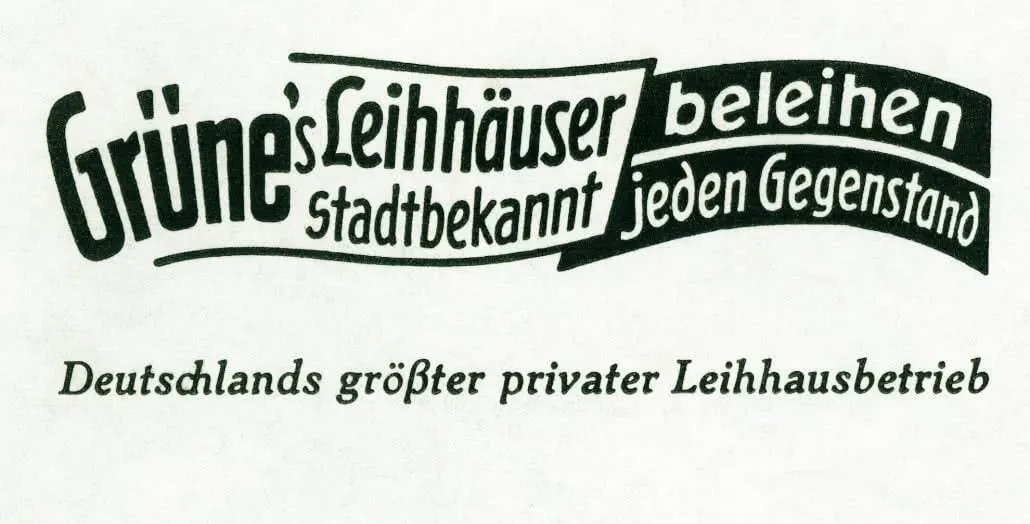
Historic advertising logo of Grüne’s Leihhäuser


What we hold on to
Customers bring their pledge, not their life story
What Hermann Grüne achieved in the fight against the industry’s bad reputation still applies unchanged today: bright premises on busy streets, fixed rules, a price that is set down in writing. No one has to explain why they come.

-
Discreet
No SCHUFA check, no proof of income, no questions asked. Your pledge is the security.
-
Transparent
Amount, term, interest and monthly costs are set out on the pawn ticket before the contract is concluded.
-
Personal
Valuations are carried out on site by trained pawnbrokers, not by a form.
Come and see us. Free valuation, no appointment needed.
Family-owned since 1932 – 18 branches across Germany, here for you.